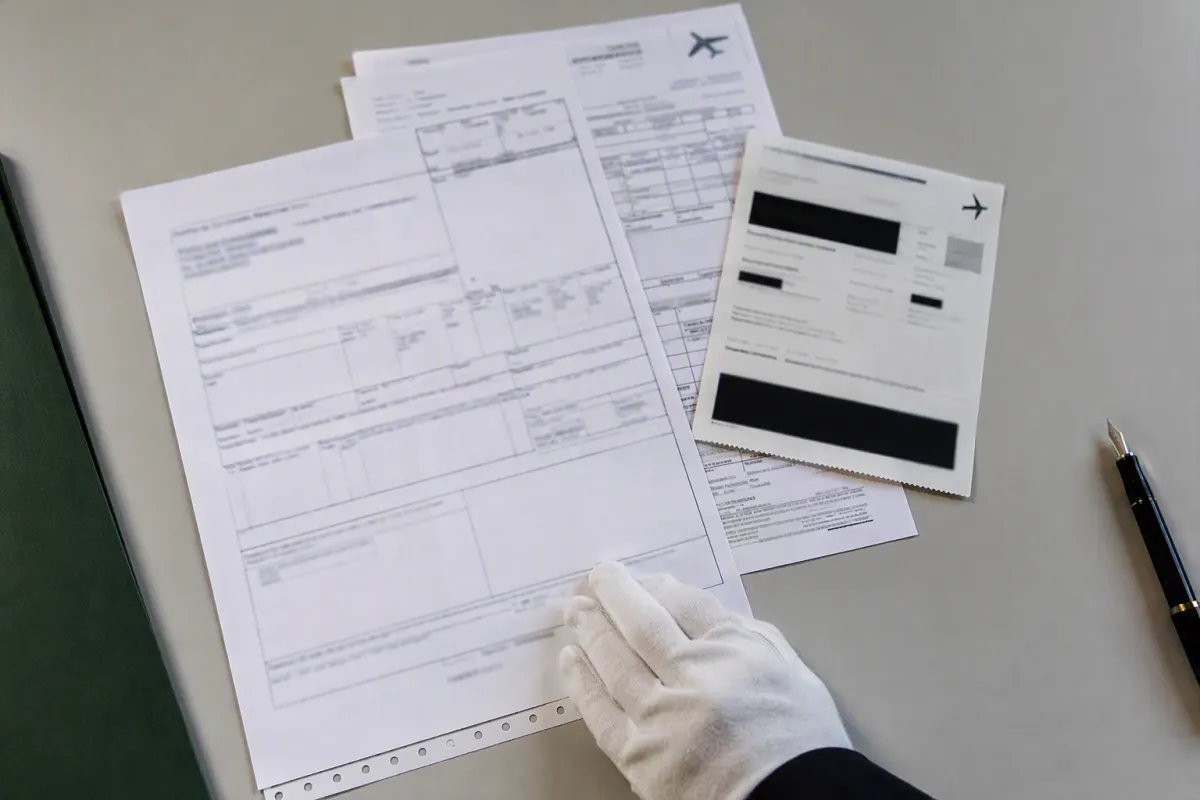

Repatriation of a deceased person from Germany to Kazakhstan is almost always carried out as air cargo in a hermetically sealed zinc-lined coffin, usually to Astana or Almaty. Once all documents are in place, it typically takes 3 to 7 working days. You will need German documents bearing an apostille, the German corpse passport (Leichenpass) and clearance with the responsible Kazakh mission — and the exact list also depends on whether the deceased was a German or a Kazakh citizen.
This guide walks through each step. Our services and guide prices are on the page Repatriation to Kazakhstan.
German or Kazakh citizen: what makes the difference
Many families repatriating a relative to Kazakhstan are ethnic Germans from the former Soviet Union who resettled in Germany. For them, citizenship is usually clear: under Kazakh law, anyone who acquires another citizenship loses Kazakh citizenship. The German Federal Foreign Office points out that this applies to acquiring German citizenship, including before October 2004. An old Kazakh passport does not change this.
- The deceased was a German citizen: the death is registered at the German civil registry office (Standesamt). For the documents to be recognised in Kazakhstan, they are prepared above all with an apostille. We establish in advance what else the Kazakh mission wants to see in the individual case.
- The deceased was a Kazakh citizen: here, too, the German registry office registers the death first. Kazakhstan’s missions abroad also offer state registration of a death that occurred abroad. The deceased’s Kazakh passport will be needed and should not be lost.
In both cases, the details in the passport, the death certificate and the corpse passport must match. Different Latin spellings of Russian or Kazakh names are among the most common reasons for queries.
Which Kazakh mission is responsible
Kazakhstan has an embassy and several consulates general in Germany. Which one is responsible depends on the federal state. According to the German Federal Foreign Office:
| Mission | Responsible for, among others |
|---|---|
| Embassy in Berlin | Berlin, Brandenburg, Mecklenburg-Western Pomerania, Saxony, Saxony-Anhalt |
| Consulate General in Frankfurt am Main | Hesse, Baden-Württemberg, Rhineland-Palatinate, Saarland |
| Consulate General in Munich | Bavaria, Thuringia |
The Federal Foreign Office also lists a consulate general in Hamburg (northern Germany) and a branch office in Bonn for North Rhine-Westphalia. Districts and opening hours change from time to time, so before every repatriation we check which office is currently the right one.
Which documents are needed
Kazakhstan used to have a specific regulation on preparing coffins and urns for dispatch to the country. It was repealed in 2014. Since then there has been no single published list; the mission decides in each case what it requires. In practice, the following is compiled for a coffin repatriation:
- Death certificate from the German registry office, if needed also as an international (multilingual) certificate;
- Apostille on the death certificate. Kazakhstan has been a party to the Hague Apostille Convention since 30 January 2001, so consular legalisation is not required. The apostille is issued by an authority designated by the federal state, not by the consulate;
- Corpse passport (Leichenpass) from the German authority where the transport begins;
- Coffining certificate from the funeral director confirming that the deceased lies in a hermetically sealed zinc-lined coffin and that the coffin contains nothing but the body;
- Certificate of freedom from infectious disease issued by a doctor or the public health office — it is frequently requested;
- Certificate of hygienic treatment or embalming where the airline or the mission requires it;
- Passport or ID of the deceased and, where applicable, confirmation from the Kazakh mission.
Whether certified translations into Russian or Kazakh are also needed, we clarify with the mission and our partner in Kazakhstan. More on the coffin itself in the article “Zinc-lined coffin for repatriation abroad”.
We do not carry out hygienic treatment of the body ourselves; we arrange it through local partners, on request in line with the family’s religious rules.
The route: air cargo to Astana, Almaty and other cities
Kazakhstan is reached almost exclusively by air. Transport by road — several thousand kilometres and several borders — is the exception.
- Direct flights: Air Astana flies from Frankfurt to Astana, Almaty and Uralsk (Oral). Whether a deceased person can travel on a particular route is decided by the airline’s cargo department.
- Connecting flights: cargo often travels via a hub. This is usually also the way to cities such as Karaganda, Shymkent, Aktobe or Pavlodar.
- Onward transport: if the home town is far from the airport, a funeral director in Kazakhstan covers the final leg.
Collection in Germany usually takes place on the same day. We book the flight as soon as the documents are complete.
How long it takes and what it costs
Once all documents are in place, a repatriation abroad with us typically takes 3 to 7 working days. Kazakhstan’s Ministry of Foreign Affairs speaks in general terms of a few days to several weeks, depending on the country and circumstances. Delays almost always occur before the flight: during death registration, while awaiting release by the public prosecutor, or because documents from Kazakhstan are missing.
| Option | Guide price from Germany | What drives the price |
|---|---|---|
| Coffin by air cargo | €6,500 – €9,500 | route and cargo rate, zinc-lined coffin, documents, destination |
| Urn | €3,500 – €4,500 | cremation, documents, transport |
Depending on the case, the collection point in Germany and onward transport within Kazakhstan are added. We send you a binding fixed price in writing within a few hours. How repatriation costs are made up in general is explained on What a repatriation from Germany costs; whether the social welfare office may pay is covered in “Repatriation abroad and the social welfare office”.
Urn instead of coffin — and questions of faith
An urn repatriation is simpler, less expensive and needs no zinc-lined coffin. Whether it is an option depends on the wishes of the deceased, the family’s faith and the cemetery at the destination.
- Muslim families: cremation is generally not accepted in Islam. What matters is swift repatriation and the ritual washing, which we arrange through partners. The funeral prayer (janazah) can take place in Germany or in Kazakhstan.
- Orthodox families: burial in a coffin is usually preferred here as well. A funeral service in an Orthodox parish in Germany before the flight can be built into the schedule.
- Urn: it requires different documents from a coffin, above all the death certificate and the cremation certificate. No corpse passport is needed.
A detailed comparison is in the article “Coffin or urn: cost, timing and faith”.
What the family in Kazakhstan can prepare
While we handle the documents and the flight in Germany, the family in Kazakhstan can prepare the following:
- Grave and cemetery: secure a plot at the chosen cemetery and provisionally agree a date for the burial;
- Name a recipient: who will receive the deceased at the cargo terminal — a relative with ID or a local funeral director;
- Customs clearance: the original documents travel with the cargo; the recipient needs copies and the air waybill number, which we send in good time;
- Transport from the airport: arrange a hearse to the home town or let our local partner take care of it.
We keep the family on both sides informed, in German, Russian or English.
Frequently asked questions
Call us — we arrange the repatriation to Kazakhstan
Tell us where the deceased is and to which city in Kazakhstan they are to be taken. We establish who is responsible, compile the documents and give you a fixed price. We will call you back within the next hour, around the clock, in English, German, Russian and Ukrainian.
- Call back within one hour
- Written fixed price within a few hours
- Around the clock, in four languages
A first conversation costs nothing and commits you to nothing.
This article reflects the published regulations and does not replace legal advice. Requirements of the missions, their districts and flight connections may change.