Few items on a repatriation invoice are explained wrongly as often as the zinc-lined coffin. Some say it is “always required for flights”, others that it is “not needed within the EU”. Neither is quite right. The requirement comes from an agreement dating from 1937, from the law of the destination country and from the airline’s rules — and in some cases it does not apply at all.
Where the rule comes from
The basis is the Berlin Agreement on the Transport of Corpses of 10 February 1937, in force since 1 June 1938. Article 3 sets out how a deceased person must be transported across borders:
- a metal coffin whose base is covered with a layer of absorbent material about five centimetres thick — peat, sawdust or charcoal mixed with an antiseptic;
- the metal coffin is soldered airtight and sealed;
- it is placed inside a wooden coffin with walls at least three centimetres thick and watertight joints;
- where death was caused by a communicable disease, the deceased is additionally wrapped in a cloth soaked in antiseptic solution.
That is why invoices sometimes say “zinc liner” and sometimes “metal inner coffin”: both describe the same construction.
Which countries are bound by the Berlin Agreement
The Federal Association of German Funeral Directors (BDB) lists the contracting states as including Austria, Belgium, the former Czechoslovakia, Egypt, France, Germany, Italy, Mexico, Portugal, Romania, Switzerland, Turkey and Zaire — today meaning the successor states of Czechoslovakia and the Democratic Republic of the Congo. Liechtenstein and Hungary apply the agreement without having formally acceded to it.
For every other destination — and that is the majority — the Berlin Agreement does not apply directly. There the law of the destination country decides, in practice as specified by its consulate in Germany. Many of these countries effectively require the same construction because they follow the same standard, and German authorities issue the corpse passport (Leichenpass) on the same basis. It is not safe to assume this, however: we check the requirement with the relevant consulate before booking and share it with you — provided the consulate gives a written answer.
What about the Strasbourg Agreement?
The Strasbourg Agreement on the Transfer of Corpses was signed on 26 October 1973 and entered into force on 11 November 1975. It provides a simplified procedure based on the corpse passport. For cases from Germany, however, it is irrelevant: Germany signed it in 1974 but never ratified it. If a source cites the Strasbourg Agreement as the basis for a repatriation from Germany, it is not reliable on this point.
One more thing for air transport
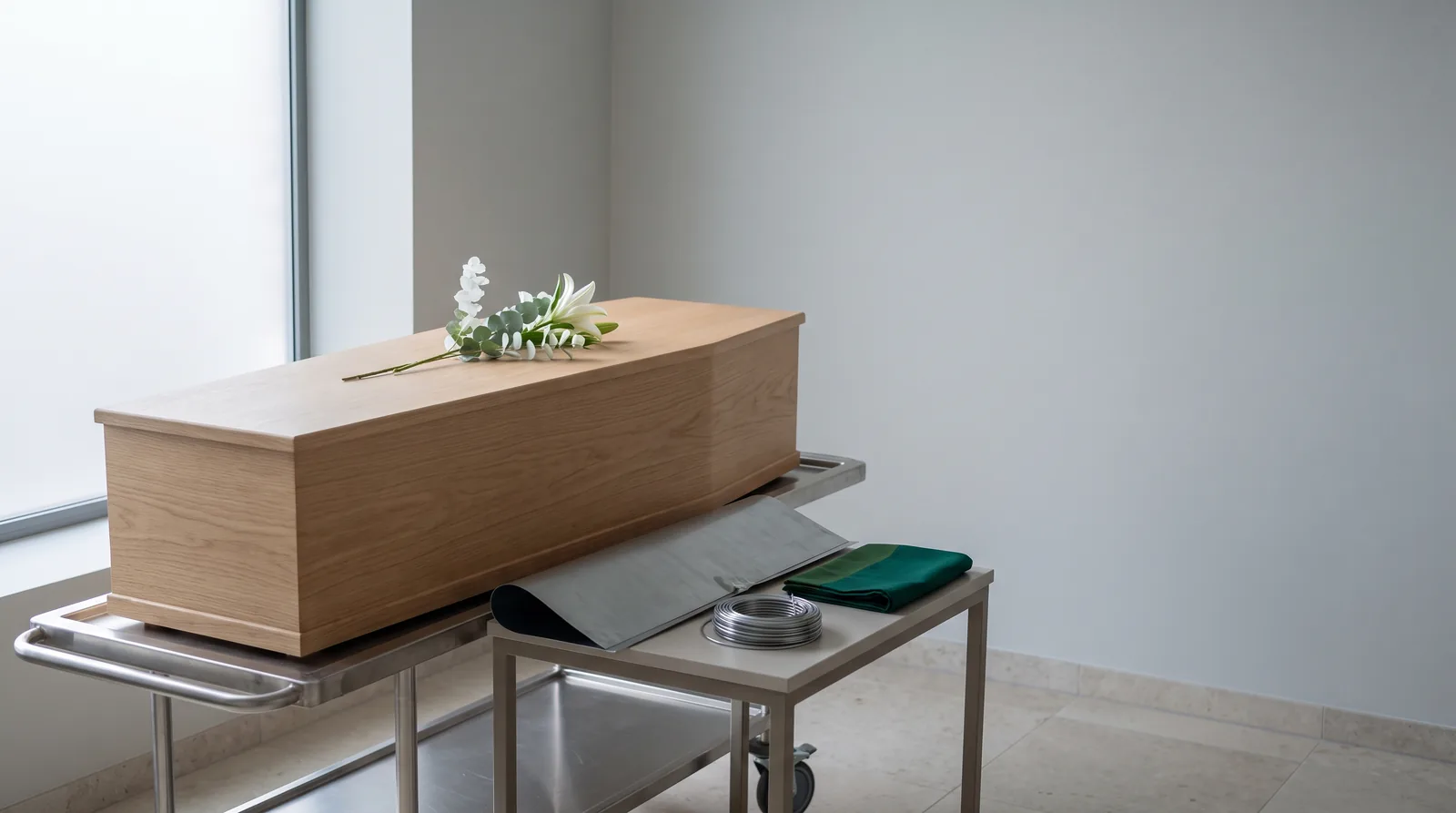
For air freight, the soldered metal coffin is fitted with a pressure-equalisation valve. Without it, the pressure difference in the cargo hold could damage the airtight coffin. The whole is then placed in a plain shipping case that gives no indication of its contents from the outside.
In many federal states the soldering takes place in the presence of an officer from the public health office, who confirms the sealing. This sealing certificate is not mere paperwork: several consulates only give their approval once it has been presented. German missions abroad, for example, explicitly list it as required for repatriations from Russia.
When a zinc-lined coffin is not needed
For an urn. The Berlin Agreement expressly does not apply to cremated remains. The metal coffin, soldering, valve and shipping case are therefore not needed — and neither is a considerable part of the cost. The documents required instead are listed on our page on urn repatriation abroad.
For transport within Germany. The rule does not apply here; the burial laws of the federal states govern. Details on the page transport within Germany.
For road transport within Europe it depends on the destination country. On some routes a simpler construction is sufficient; on others the same is required as for a flight. There is no general answer — and anyone who gives one is guessing.
What a zinc-lined coffin costs
To help you place this item on an invoice, here are typical figures from quotes that families have shown us for comparison. These are not our prices:
| Item | Typical market price |
|---|---|
| Zinc coffin or zinc liner, basic | from about €500 |
| Air transport coffin with zinc liner | about €1,550 |
| Pressure-equalisation valve | about €80 |
| Soldering in the presence of the public health office | about €190 plus a fee of around €50 |
Our fixed price already includes the transport coffin with zinc liner; it is not charged separately. The full breakdown by destination region is on the page repatriation costs.
Frequently asked questions
If in doubt, we check before you pay
For every destination we confirm the specific requirement with the relevant consulate before we give you a fixed-price quote. If a simpler construction is sufficient, we tell you — and the price comes down accordingly.
Phone: +49 1511 7463888, around the clock · Request a call back
This article reflects the published regulations and does not replace legal advice. The requirements of the competent authority and the destination country are binding.