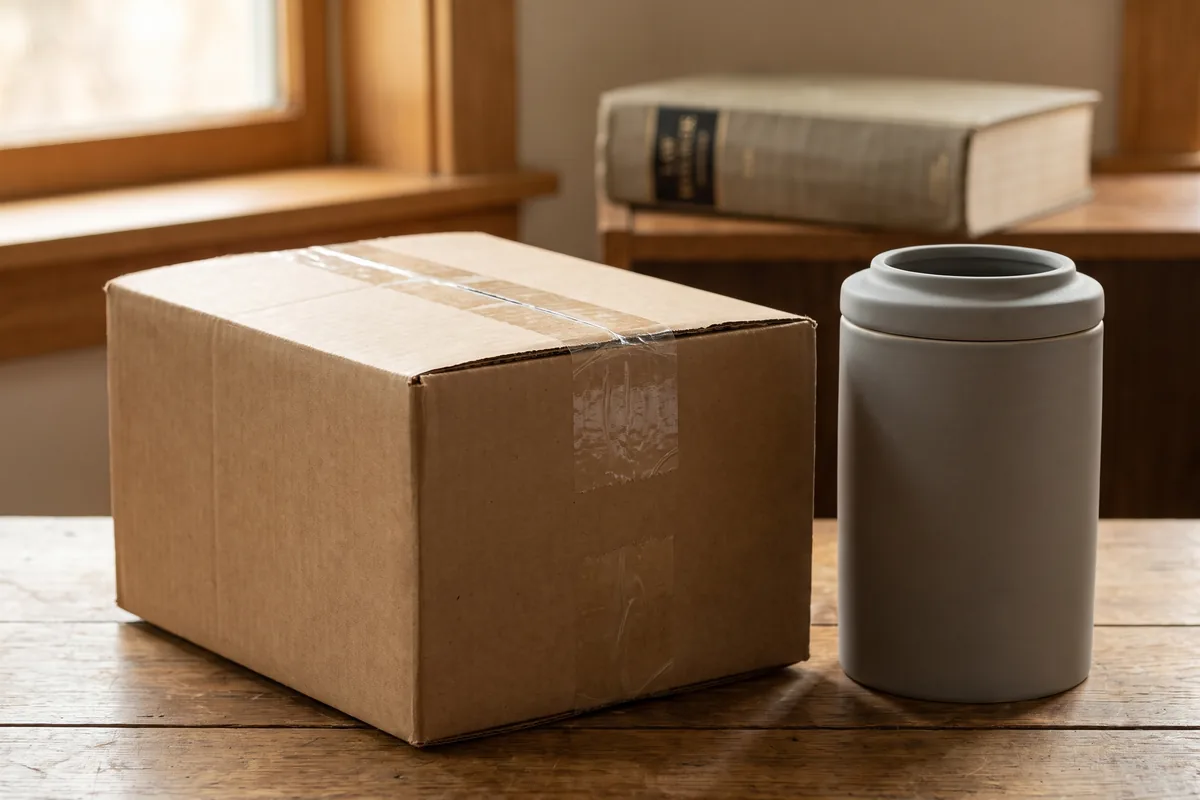
You can no longer send an urn by post in Germany, and relatives may transport it themselves only within narrow limits. Ashes are subject to the same duty of burial as a body: the urn has to be laid to rest in a permitted place, and the journey there requires documents, proof of burial and, for travel abroad, compliance with the rules of the airline and the destination country. Shipping an urn from Germany to another country is therefore almost always handled by a funeral director. This guide explains what applies, how the federal states differ and how the repatriation works.
The duty of burial also applies to ashes
In Germany, funeral law is a matter for the federal states. Almost all of them share what is known as the cemetery requirement (Friedhofszwang): the urn is buried in a cemetery, in a designated burial forest or at sea. Burial at sea is permitted as an exception in every state. Taking the urn home, keeping it in the living room or scattering the ashes in the garden is not allowed in most states.
The consequence: legally, an urn is not an ordinary object that can be kept, given away or posted as a parcel. Every journey has a destination, a place of burial, and that place must be known before the crematorium releases the urn. The details depend on the state in which the cremation took place. General information on deadlines and procedure is on our page about cremation.
How the federal states differ
Some states have relaxed their rules in recent years. The table lists only provisions backed by the law itself or by official guidance; in practice they are narrower than news headlines suggest.
| State | What applies to the urn |
|---|---|
| North Rhine-Westphalia | The crematorium may hand the sealed urn to the bereaved or to persons they have authorised, for transport to the place of burial. Proper burial must be proven to the crematorium within six weeks, usually by a certificate from whoever carried it out (section 15(5) BestG NRW). |
| Bremen | Since 2015, ashes may under certain conditions be scattered outside a cemetery, for example on private land. Conditions include a last main residence in the state of Bremen, a written instruction from the deceased naming the place and a responsible person, and the landowner’s consent. Even there, the urn may not be kept at home permanently. |
| Rhineland-Palatinate | Since the 2025 reform, burials outside a cemetery are possible under strict conditions, for example in certain rivers. They require a written instruction from the deceased (Totenfürsorgeverfügung) and a last main residence in Rhineland-Palatinate; the burial must take place within the state. |
| Other states | The cemetery requirement remains essentially unchanged. Each state decides whether and on what conditions the urn is released to relatives; often it goes straight from the crematorium to the funeral director or the cemetery. |
Important for families abroad: the relaxations in Bremen and Rhineland-Palatinate concern forms of burial within those states. They are not a general permission to take an urn across a border privately. If the urn is to be buried abroad, the requirements of the destination country, the airline and, where applicable, the consulate also apply.
Sending an urn by post: no longer possible since October 2025
Many guides online still describe sending an urn with DHL. That information is out of date: Deutsche Post and DHL stopped carrying urns on 1 October 2025, both within Germany and internationally. With other parcel and courier services an urn is not an ordinary parcel either; their conditions of carriage decide, and without a recipient who takes charge of the burial such a shipment is not permitted in any case.
Anyone searching today for how to ship ashes internationally therefore almost always ends up with a funeral director, who arranges air cargo or a specialist funeral courier and hands the urn over to a funeral home or cemetery in the destination country.
Why shipping an urn abroad goes through a funeral director
Cremated remains are not dangerous goods. The difficulties lie elsewhere:
- Documents. Usually required are the international death certificate, the cremation certificate and a certificate of the urn’s contents. Some destination countries also require an apostille or legalisation and a consular permit. What each country expects is set out in our guide on the death certificate apostille.
- Airline rules. Each airline decides for itself whether and how it carries urns: as cargo, with advance notice, with specific papers or in a container that can be X-rayed at security.
- Reception in the destination country. At the airport someone has to take over the urn with its papers, clear the import checks and bring it to the cemetery.
- Proof of burial. Depending on state law, the burial must be proven to the crematorium; in North Rhine-Westphalia within six weeks.
The full list of permits is in our guide “Taking ashes abroad from Germany: which permits and documents you need”.
Customs clearance of the urn in the destination country
On import, the urn is checked together with its papers, depending on the country by customs, the health authority or both. The main question is whether the death certificate, cremation certificate and cargo documents match and whether any required certifications are present. Even a different spelling of the name can mean the urn stays in the terminal until the matter is resolved. Whether import fees apply, and how much, is decided by each destination country.
Clearance is handled by our partner funeral director on site, who knows the local procedure, receives the urn at the cargo terminal and confirms receipt to us. How you can follow the urn until then is explained in “Tracking an urn repatriation”. Similar rules apply in the other direction; see “Bringing ashes to Germany”.
Scattering or burying ashes abroad
Many families want to scatter the ashes in their home country or bury the urn in a family grave. Whether that is allowed depends on the law of the destination country. In Switzerland, for example, cantonal law usually lets families take the urn home, and scattering ashes is permitted in many places. Other countries have rules as strict as Germany’s, or require permission from the municipality or cemetery.
Before booking, we check with our partner which form of burial is permitted locally. The partner receives the urn, accompanies the burial or scattering in line with local rules and issues the confirmation the German crematorium needs as proof.
What Ritual-Service24 takes care of
For over 20 years we have repatriated the deceased and urns to more than 30 countries, both from Germany and to Germany. For you this means:
- collection of the deceased in Germany, usually on the same day, and arrangement of the cremation;
- obtaining and certifying the documents, with a consular permit where required;
- booking air cargo or a specialist courier and packing the urn securely;
- handover to our partner funeral director in the destination country and proof of burial;
- a written fixed price within a few hours; urn repatriations are available from €990.
A repatriation abroad typically takes 3 to 7 working days. Details of the process and our services are on the page Urn repatriation abroad.
Frequently asked questions
We bring the urn safely to its place of rest
Tell us the destination country and where the deceased or the urn is now. We arrange the documents, transport and handover to our partner in the destination country and take care of the proof of burial. You will receive a call back within the next hour.
- Call back within one hour
- Written fixed price within a few hours
- Around the clock, in four languages

A first conversation costs nothing and commits you to nothing.
This text reflects the published regulations at the time of writing and is not legal advice. Requirements for documents, deadlines and forms of burial vary by federal state, destination country and airline and may change.