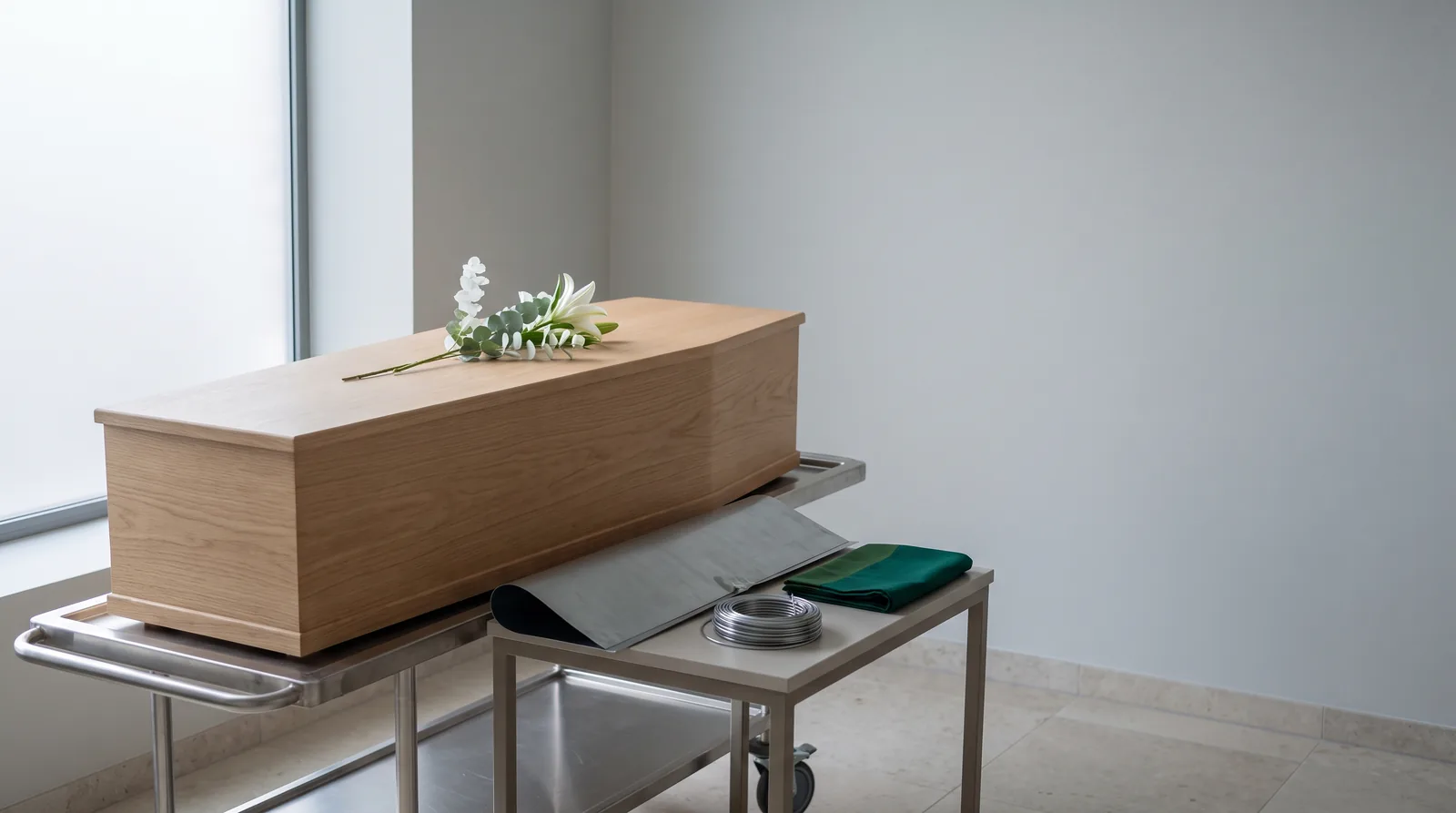

Losing someone close is emotionally exhausting, and it often comes with substantial costs for the funeral and for settling the estate. Many families do not realise that part of this expenditure can be claimed against tax in Germany. The important distinction is between income tax and inheritance tax .
Funeral costs as an extraordinary burden (außergewöhnliche Belastung)
Close relatives — a spouse, children or parents — may under certain conditions declare funeral costs in their income tax return as an extraordinary burden under section 33 of the German Income Tax Act (EStG).
This is possible where:
- there was a legal or moral obligation to bear the costs,
- the costs were not covered by the estate or by funeral insurance,
- the expenses were actually borne personally.
Typically deductible costs include:
- the funeral director
- the coffin or urn
- the transport
- cemetery fees
- the headstone
- the initial planting of the grave
- death notices
- reasonable costs of the funeral service
Costs for mourning clothes, catering for guests, travel or ongoing grave care are generally not deductible.
How large is the reasonable own share? A worked example
A point many people overlook: an extraordinary burden does not count in full. The tax office first deducts an own share, the so-called zumutbare Belastung (reasonable own share). Only the portion of the costs above that threshold reduces the tax.
The size of this own share depends on total income, marital status and the number of children. Since a ruling of the Federal Fiscal Court (BFH, case VI R 75/14) it is calculated in bands: each percentage applies only to the corresponding slice of income, rather than the highest rate applying to the whole.
| Total income | up to €15,340 | 15.340–51.130 € | over €51,130 |
|---|---|---|---|
| Single, no children | 5 % | 6 % | 7 % |
| Married, no children | 4 % | 5 % | 6 % |
| 1–2 children | 2 % | 3 % | 4 % |
| 3 or more children | 1 % | 1 % | 2 % |
Example: An unmarried daughter with a total income of €40,000 pays €9,000 for the funeral. She receives €3,000 from funeral insurance, so she has borne €6,000 herself.
Her reasonable own share is calculated as follows:
- up to €15,340 × 5 % = €767.00
- the remaining €24,660 × 6 % = €1,479.60
- total own share: €2,246.60
The amount that counts for tax is therefore €6,000 − €2,246.60 = 3.753,40 €, which can be claimed as an extraordinary burden. The tax office calculates the own share automatically — you simply state the full amount you paid yourself.
The flat-rate deduction for estate costs (Erbfallkostenpauschale)
An heir can additionally benefit from the flat-rate deduction under section 10(5)(3) of the German Inheritance Tax Act (ErbStG).
For deaths from 1 January 2025 onwards this flat rate is €15,000. Until 31 December 2024 it stood at €10,300. The increase came with the Annual Tax Act 2024.
The advantage is that no individual receipts are generally required up to that amount. In 2023 the Federal Fiscal Court confirmed that the deduction is granted without the actual costs having to be evidenced in detail. Where the real costs exceed the amount, the higher figure can be claimed with supporting documents.
The deduction covers, among other things:
- funeral costs
- the cost of a memorial and customary grave care
- notary fees
- the certificate of inheritance
- the costs of settling the estate
Note: the deduction applies once per estate, not per person. Where several people inherit together, it is divided between them according to their shares.
Repatriation costs abroad — a case of its own
It is with a repatriation abroad that the tax side is especially worth looking at. Transporting the deceased counts as a funeral cost and can therefore — where reasonable in amount and borne personally — be taken into account both as an extraordinary burden for income tax and within the flat-rate deduction for inheritance tax.
When someone is returned to their home country — one of the CIS states, say — the cost of the coffin, the documents, the flight and the transport is usually far higher than for a funeral locally. That is precisely why the tax relief matters here. What counts is that the expenses were unavoidable and reasonable in amount, and that every invoice is kept.
As a company specialising in international repatriation we invoice every service transparently, so that the documentation for the tax return is complete.
Important: income tax and inheritance tax are not the same thing
A common mistake is to confuse the flat-rate estate deduction with the extraordinary burden.
- Income tax: Here, funeral costs actually borne personally can be counted as an extraordinary burden.
- Inheritance tax: Here, the flat-rate deduction reduces the heir’s taxable acquisition.
The two rules serve different tax purposes and can, depending on the case, both be relevant at once.
In short
After a death, families should keep every invoice and receipt carefully. Depending on the situation, both funeral costs under income tax and estate costs under inheritance tax can bring a tax advantage. Since every case is different, individual tax advice is worth seeking where the estate is large or the funeral costs high.
Frequently asked questions
Are repatriation costs abroad tax-deductible?
Yes. The transport counts as a funeral cost and can — where reasonable and borne personally — be claimed both as an extraordinary burden and within the flat-rate estate deduction.
Does the flat-rate deduction apply per heir or per estate?
Per estate. It is €15,000 once, for deaths from 2025 onwards. Where there are several heirs the amount is divided according to their shares.
Do I have to submit receipts for the flat-rate deduction?
No. Up to €15,000 no individual evidence is required. Receipts are only needed once the actual costs exceed that figure.
Can I use the income tax and inheritance tax advantages at the same time?
In principle yes, since these are different taxes. As an extraordinary burden, however, only costs not covered by the estate are deductible.
Is grave care deductible?
Customary grave care falls under the flat-rate deduction for inheritance tax. Ongoing grave maintenance, by contrast, is not an extraordinary burden for income tax.
This article is general information and does not replace individual tax or legal advice.