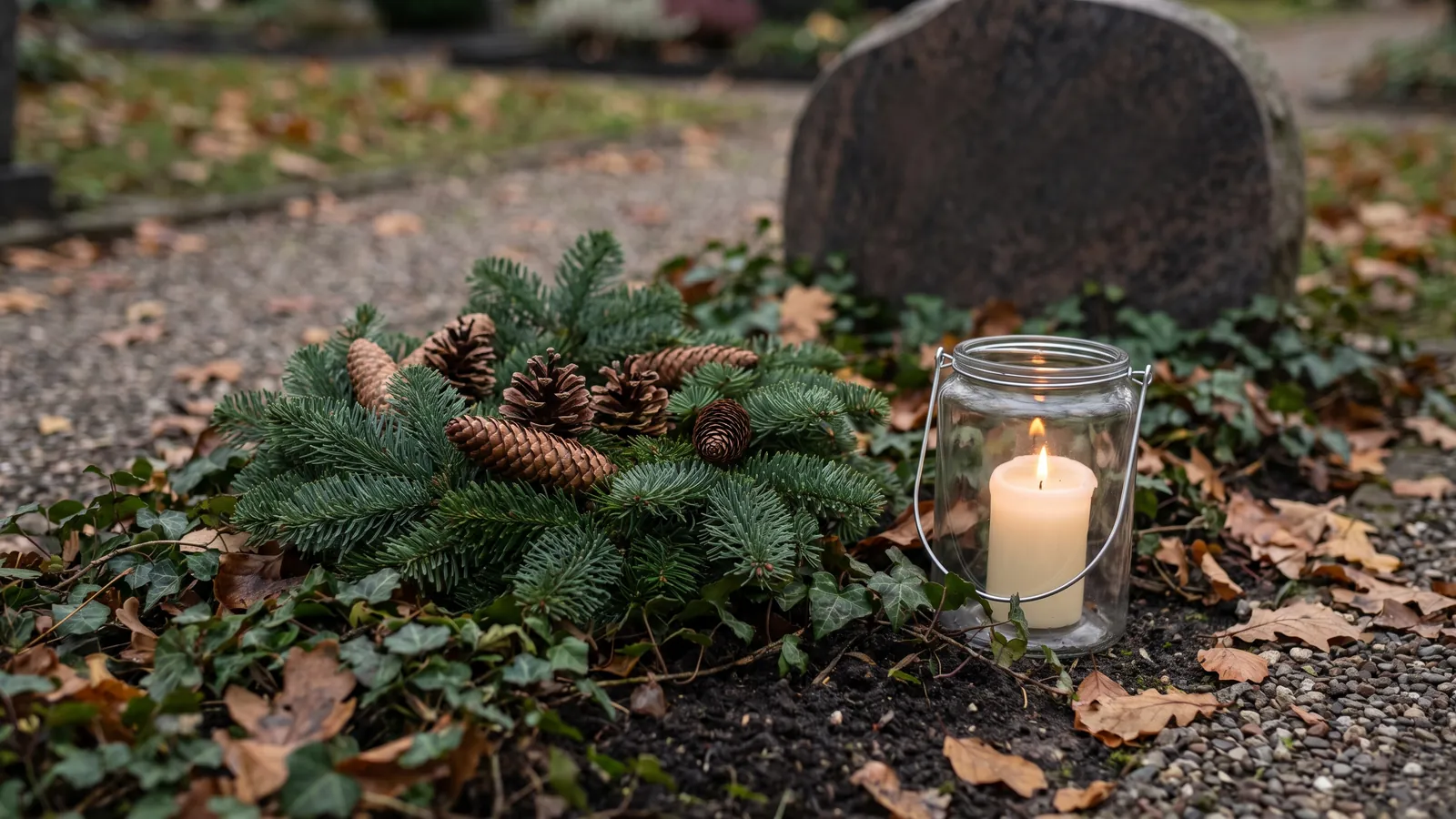
November is the month in which families in Germany remember their dead: All Saints’ Day on 1 November 2026, All Souls’ Day on 2 November, the National Day of Mourning on 15 November and Totensonntag (Sunday of the Dead) on 22 November. Orthodox Christians keep Demetrius Saturday – on 7 November 2026 under the Julian calendar, and already on 24 October in the Orthodox Church of Ukraine. If the grave is far away, its care can be arranged through a cemetery gardener or a grave care service; if the distance has become permanent, relocating the urn closer to the family is an option worth looking into.
Days of remembrance in autumn 2026 at a glance
| Date 2026 | Day of remembrance | Tradition | Note |
|---|---|---|---|
| Sat, 24 October | Dmytrivska Saturday | Orthodox Church of Ukraine | Revised Julian calendar; since 2023, 13 days earlier than before |
| Sun, 1 November | All Saints’ Day (Allerheiligen) | Catholic | public holiday in Baden-Württemberg, Bavaria, North Rhine-Westphalia, Rhineland-Palatinate and Saarland |
| Mon, 2 November | All Souls’ Day (Allerseelen) | Catholic | not a public holiday; traditional day for visiting graves |
| Sat, 7 November | Demetrius Saturday (Dmitrievskaya subbota) | Orthodox, Julian calendar | Saturday before the feast of St Demetrius on 8 November |
| Sun, 15 November | National Day of Mourning (Volkstrauertag) | state commemoration | two Sundays before the first Sunday of Advent; not a public holiday |
| Sun, 22 November | Totensonntag / Ewigkeitssonntag | Protestant | last Sunday before Advent; not a public holiday, but a “quiet day” in several states |
For families with relatives of different denominations, this means a day of remembrance almost every week from late October to late November. If you want to order a wreath or autumn clean-up for a distant grave, it is best to contact a gardener at the beginning of October.
All Saints, All Souls, the Day of Mourning and Totensonntag
All Saints’ Day (1 November) honours all saints, All Souls’ Day (2 November) is the day for remembering all the dead, especially one’s own family. Because All Saints’ Day is a day off in five federal states, many families visit graves on that day already, and many Catholic parishes bless the graves.
The National Day of Mourning on 15 November 2026 is a state day of remembrance for the victims of war and tyranny. Totensonntag, also called Ewigkeitssonntag (Eternity Sunday), is the Protestant day of remembrance for the dead; in 2026 it falls on 22 November. In many congregations, the names of those who died during the past church year are read out during the service.
In several federal states, All Saints’ Day and Totensonntag are “quiet days”: loud events and dancing are restricted at certain hours. Each state sets its own rules.
Orthodox remembrance: Demetrius Saturday and Radonitsa
The Orthodox tradition has several Saturdays of the dead on which churches pray for the departed. Demetrius Saturday (Russian Dmitrievskaya roditelskaya subbota) is the Saturday before the feast of St Demetrius of Thessaloniki. Churches following the Julian calendar – including the Russian Orthodox Church – celebrate the feast on 8 November, so in 2026 Demetrius Saturday falls on 7 November.
The Orthodox Church of Ukraine switched to the Revised Julian calendar in September 2023, moving all fixed feasts 13 days earlier. There, Dmytrivska Saturday falls on 24 October in 2026. Ukrainian families may therefore observe either date, depending on their parish.
The main spring commemoration is Radonitsa (Ukrainian Radonytsia, also known as “Provody”), the ninth day after Easter. In 2026 it fell on 21 April. Families visit graves with painted eggs and Easter bread. The date of Easter was not affected by the Ukrainian calendar reform.
Customs at the grave
- Grave candles: the light on the grave stands for hope beyond death. Around All Saints’ Day and Totensonntag, many cemeteries are lit by countless candles.
- Arrangements and wreaths: arrangements of fir branches, cones and hardy flowers last through the winter. The wreath, a circle without beginning or end, symbolises eternity.
- Autumn care: removing leaves and summer plants and covering the grave with fir branches.
- Church remembrance: on Saturdays of the dead, Orthodox parishes accept notes with the names of the departed to be prayed for.
Grave care from abroad: what families can do
Many families live in Germany while their parents are buried in Kazakhstan, Ukraine or the Caucasus. Sometimes it is the other way round: the grave is in Germany and the children have moved abroad. For a grave in Germany, there are established ways to arrange care from a distance.
Long-term grave care with a trust body (Dauergrabpflege). You sign a contract with a cemetery gardener and a trust organisation for long-term grave care. The full cost is paid once in advance into a trust account kept separate from business assets. The trust pays the gardener every year and has the work inspected regularly. If the business closes, the care is transferred to another firm. A term of at least five years is recommended; many contracts run for 25 years or longer. You choose the scope, from basic upkeep to seasonal planting and a wreath for Totensonntag.
One-off orders. If you do not want a long-term contract, you can hire a gardener or grave care service for individual jobs, such as autumn care and a candle for All Saints’ Day. Agree in writing what will be done and ask for photos before and after. That way you can see the state of the grave even from far away. One way to find providers in Germany is the marketplace irespect.com, through which grave care orders are placed with service providers.
If the grave is in the home country, relatives, neighbours or the cemetery administration often help. Agreeing on photos as proof is worthwhile there too. For the types of graves in Germany, see our pages on types of funeral and burial.
When the distance remains: relocating and repatriating the urn
Some families decide after a few years that their loved one should rest where the family lives today. With an urn this is more feasible than with a coffin – but never without permission. The rest of the dead is protected by law; the rules are set by each federal state’s burial law and the cemetery’s own regulations. Three examples:
- Lower Saxony: before the minimum rest period ends, bodies and ashes may only be exhumed or reinterred with the approval of the lower health authority, and a detailed justification is required. After that, the cemetery operator decides. The district of Wolfenbüttel, for example, lists administrative fees of 45 to 250 euros, plus cemetery fees.
- North Rhine-Westphalia, Dortmund example: the cemetery administration, acting as the local regulatory authority, grants permission only for an important reason – such as reuniting family members in one grave or a permanent change of residence of the applicant. For coffin burials, a certificate from the health authority is also required.
- Rhineland-Palatinate: under the new burial act, no important reason is needed once the statutory minimum rest period has expired – five years for urns. The Higher Administrative Court of Rhineland-Palatinate confirmed this in October 2025.
The application is usually made by the holder of the grave’s right of use. Once approved, the actual repatriation follows: an urn going abroad needs, among other things, the death certificate and the cremation certificate, plus further documents depending on the destination country. Details are in our guide “Taking ashes abroad from Germany: which permits and documents you need”. How we handle it is described on the page Urn repatriation abroad.
The reverse is also possible: bringing an urn from the home country to Germany when the family lives here. The rules of the country where the urn is buried apply first, and in Germany it needs a place of burial. More in “Bringing ashes to Germany”. Relocating a coffin abroad is considerably more complex and has to be assessed case by case.
Frequently asked questions
The grave is too far away? Let us talk through the options
If you are thinking of bringing an urn from Germany to your family abroad, or from your home country to Germany, we clarify with the cemetery and the authorities which permits are needed and organise the repatriation. We have been working for over 20 years and repatriate to more than 30 countries. You receive a written fixed price within a few hours and a call back within the next hour – in English, German, Russian and Ukrainian.
- Call back within one hour
- Written fixed price within a few hours
- Around the clock, in four languages
A first conversation costs nothing and commits you to nothing.
This article reflects published regulations and church calendars and does not replace legal advice. Rules on relocating graves vary between federal states and cemetery regulations and may change.