In Germany, an urn is generally not handed over to the family. The reason is the mandatory cemetery burial rule (Friedhofszwang): ashes must be interred in a cemetery or at sea. Taking ashes abroad is still possible – but only with permits, a complete set of documents and proof that the urn has been interred in the destination country. Exactly which papers are needed depends on the German federal state, the destination country and the way the urn travels. The safest route is to leave the repatriation to a funeral service that knows these procedures.
What the law says
Burial law in Germany is set by the 16 federal states. All of them follow the same principle: ashes are interred, not kept at home. In North Rhine-Westphalia (NRW), for example, ashes must be interred within six weeks (§ 13(3) BestG NRW). The crematorium records who received the urn and where it ends up.
Only two states allow exceptions, and the conditions are strict:
- Rhineland-Palatinate: since 27 September 2025, an urn may be kept at home – if the deceased set this out in a written declaration (Totenfürsorgeverfügung) and had their main residence in Rhineland-Palatinate.
- Bremen: since 2015, ashes may under certain conditions be scattered on private land, if the deceased wished so in writing and was last registered in Bremen.
Burial abroad. For this case, NRW law allows the sealed urn to be released for transport to the place of interment (§ 15(5) BestG NRW). The condition: within six weeks, the crematorium must receive a certificate from whoever carried out the interment, such as the cemetery in the destination country. Without this proof, fines of up to €3,000 are possible (§ 19 BestG NRW).
Other states have similar but not identical rules. Some places of interment require a special permit from the authorities. How seriously this is taken is shown by a case from Baden-Württemberg: in 2019, the Tübingen local court fined a crematorium operator who had released an urn for an interment in Switzerland without such a permit.
Bringing an urn back privately is not allowed. Once an urn arrives in Germany, state law applies again. According to Germany’s missions abroad, urns in Germany are delivered only to cemetery administrations or funeral directors, never to private individuals. More on our page about repatriation to Germany.
Which documents and permits are needed
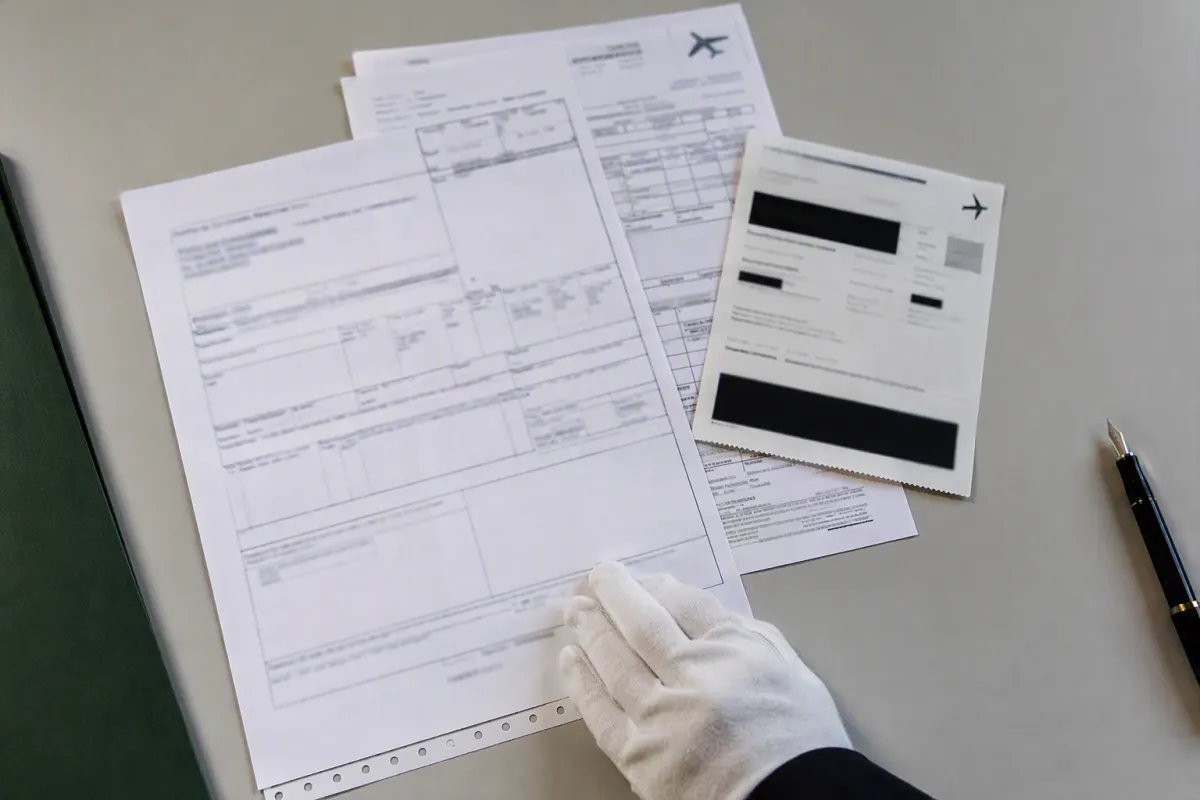
The table shows the documents typically required to take ashes abroad from Germany. Not every country asks for all of them, and some ask for more.
| Document | Issued by | Purpose |
|---|---|---|
| International (multilingual) death certificate | Registry office (Standesamt) where the death occurred | Proof of death for authorities, consulate, airline and cemetery |
| Cremation certificate (Einäscherungsbescheinigung) | Crematorium | Confirms that and where the cremation took place |
| Urn certificate (Urnenbescheinigung, “Urnenpass”) | Crematorium or funeral director | Confirms the contents of the sealed urn; not an official document like the coffin passport (Leichenpass) |
| Permit from the local authority (Ordnungsbehörde), where required | Competent authority in Germany | Exceptions, e.g. for interment outside a cemetery; rules vary by state |
| Confirmation of interment | Cemetery or funeral director in the destination country | First as consent to receive the urn, then as proof for the crematorium (in NRW within six weeks) |
| Import permit or consular certificate | Consulate of the destination country | Permission to bring in the ashes; Poland, for example, issues its own consular certificate (fee €60 according to its mission) |
| Translations, apostille or legalisation | Sworn translators, competent German authority | If the destination country only accepts German documents translated or certified |
| Customs documents | Funeral service or freight forwarder | For countries outside the EU, under their rules |
| Written airline approval or air waybill | Airline | Carriage by plane, as baggage or as air cargo |
Why carrying ashes on a plane or by car often fails
Families often ask: “Can I take ashes on a plane myself?” Legally, the scope is narrow: the urn is only released under conditions, and every stage of the journey has its own rules. In practice, it most often fails here:
- Every airline has its own rules. Some allow an urn only in hand luggage, others in checked baggage too, others publish no rules at all. Many require a specific container and copies of the certificates. Without written approval, you may be turned away at the gate.
- Security screening. The urn is X-rayed, and staff must be able to see what is inside. Germany’s missions abroad point this out explicitly. At the same time, the sealed ash capsule must not be opened.
- Border and customs checks. Outside the EU – for example on the way to Turkey, the Caucasus or Central Asia – customs and border authorities apply their own rules.
- Missing translations or apostille. Many authorities abroad only accept German documents with an apostille or legalisation. One missing stamp and the urn is held in the destination country.
- No more postal shipping. DHL and Deutsche Post stopped shipping urns on 1 October 2025, both within Germany and abroad. Specialist carriers work on behalf of funeral directors and crematoria, not private individuals.
There is also the deadline: proof of interment must reach the crematorium in Germany in time. If the trip is delayed or a document is missing, the responsibility lies with the family. You do not have to carry that responsibility yourself.
What we take care of
Ritual-Service24 has been repatriating the deceased and urns for over 20 years, to more than 30 countries. For an urn repatriation, we handle the entire process:
- all documents and permits, including translations and certifications if the destination country requires them
- coordination with the crematorium, authorities and the destination country’s consulate
- booking with the airline or as air cargo
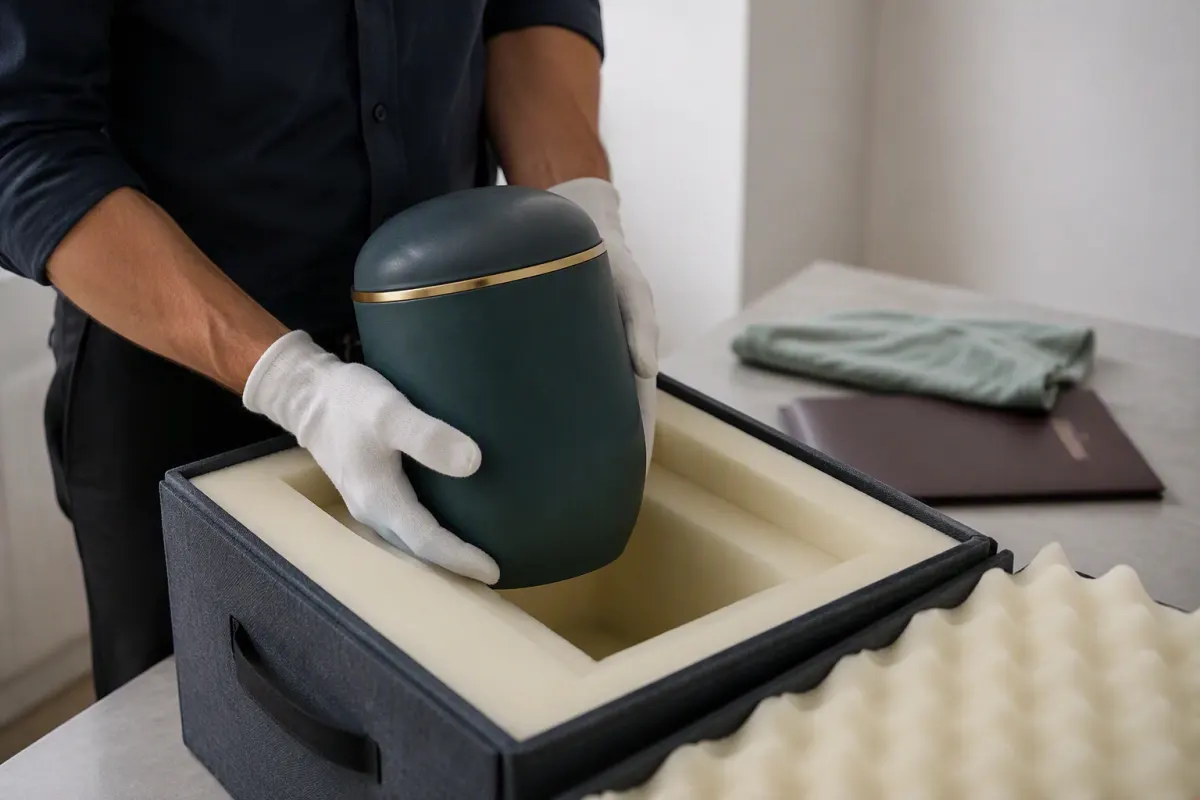
- safe and dignified packaging of the urn
- tracking via the air waybill number (AWB), which you receive from us
- handover to the cemetery or our partner funeral director in the destination country
Simple urn repatriations start at €990. Guide prices for taking an urn abroad: Georgia, Armenia and Azerbaijan €2,500–3,500; Ukraine, Kazakhstan and Central Asia €3,500–4,500; Russia €4,500–7,500. Cremation in Germany is not included. For your specific case, you receive a written fixed price within a few hours.
Full details on our page Urn repatriation abroad.
Frequently asked questions
Talk to us before you book anything
Ideally, call us before you arrange the cremation or book a flight. We can then check what the federal state and the destination country require and prepare the documents correctly from the start. We are available around the clock and advise in English, German, Russian and Ukrainian.
Phone: +49 1511 74 63 888, 24/7 · Request a call back
This information reflects published law as of September 2026 and is not legal advice. The competent authority, the consulate and the airline have the final say.