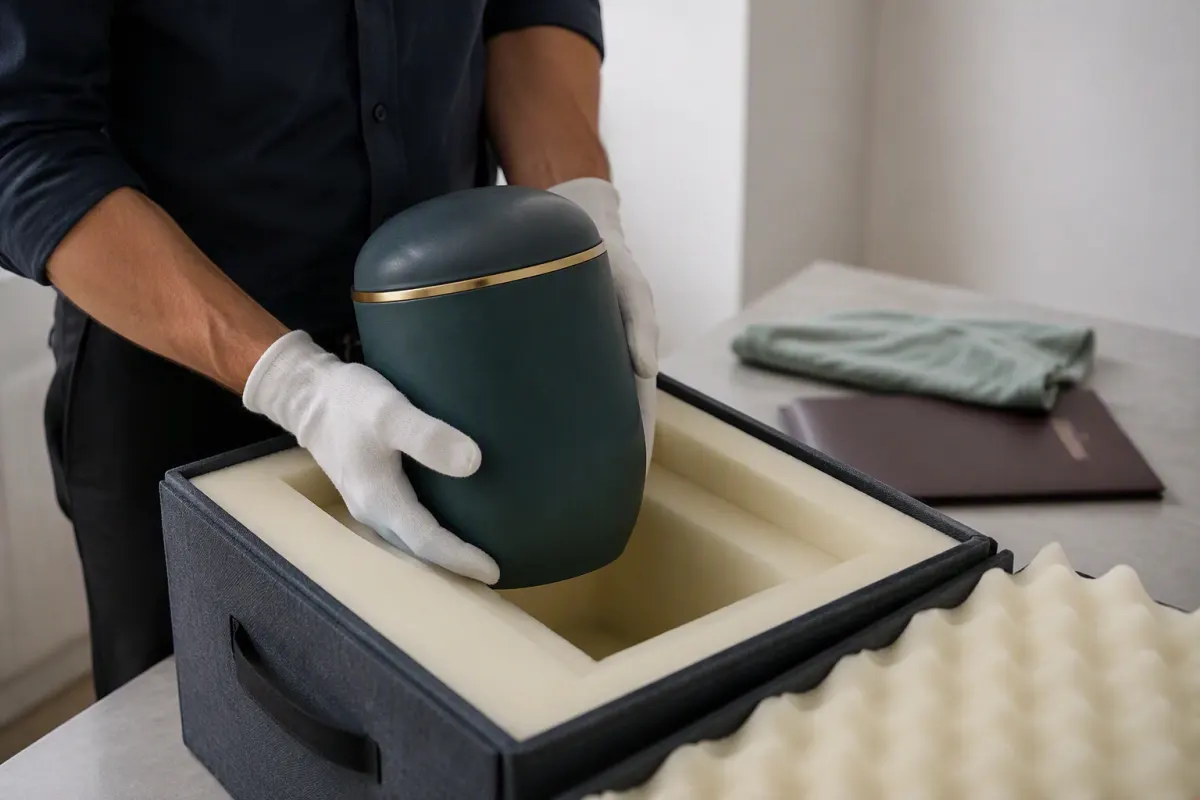
Yes, you can bring ashes to Germany from abroad, and no customs duty is charged: urns containing the ashes of the deceased are exempt from import duties. Two other things matter more. First, the paperwork — above all the death certificate and the cremation certificate, and for countries outside the EU usually an urn certificate from the German embassy or consulate as well. Second, Germany’s mandatory cemetery burial (Friedhofszwang): even if the person was cremated abroad, the urn is buried in a cemetery or at sea once it is in Germany. Our guide price for bringing an urn to Germany is €1,500–3,500, plus the cemetery fees in Germany.
Can you take an urn to Germany?
Importing the urn is allowed. What happens to it afterwards, however, is not decided by the country where the cremation took place but by the burial law of the German federal state where the urn is laid to rest. In North Rhine-Westphalia, for example, section 15(5) of the state burial act (BestG NRW) states that the container with the ashes must be buried in a cemetery or at sea. Almost all federal states have similar rules.
Families often ask us: if the cremation took place in the Netherlands, Switzerland or France, where urns are handed to relatives, can the urn stay at home in Germany? As a rule, no. Once the urn is in Germany, German state law applies. Keeping ashes at home or scattering them in the garden is an administrative offence in most federal states.
The exceptions: Bremen and Rhineland-Palatinate
- Bremen has allowed ashes to be scattered on private land or designated areas since 2015. Conditions: the deceased’s last main residence was in Bremen, and they specified the place in writing beforehand. Keeping the urn at home permanently is not allowed in Bremen either.
- Rhineland-Palatinate brought Germany’s most liberal burial law into force in autumn 2025. The urn may be handed to relatives, and ashes may be scattered or buried in certain rivers. Conditions: last main residence in Rhineland-Palatinate and a wish set down in writing during the person’s lifetime, for example in a funeral directive (Totenfürsorgeverfügung).
Other states have modernised their laws — Schleswig-Holstein, for example, in 2026 — but kept mandatory cemetery burial for urns. We check whether your case falls under an exception before the transfer, not once the urn has arrived. Burial at sea is a permitted alternative to a cemetery throughout Germany.
Which documents the urn needs
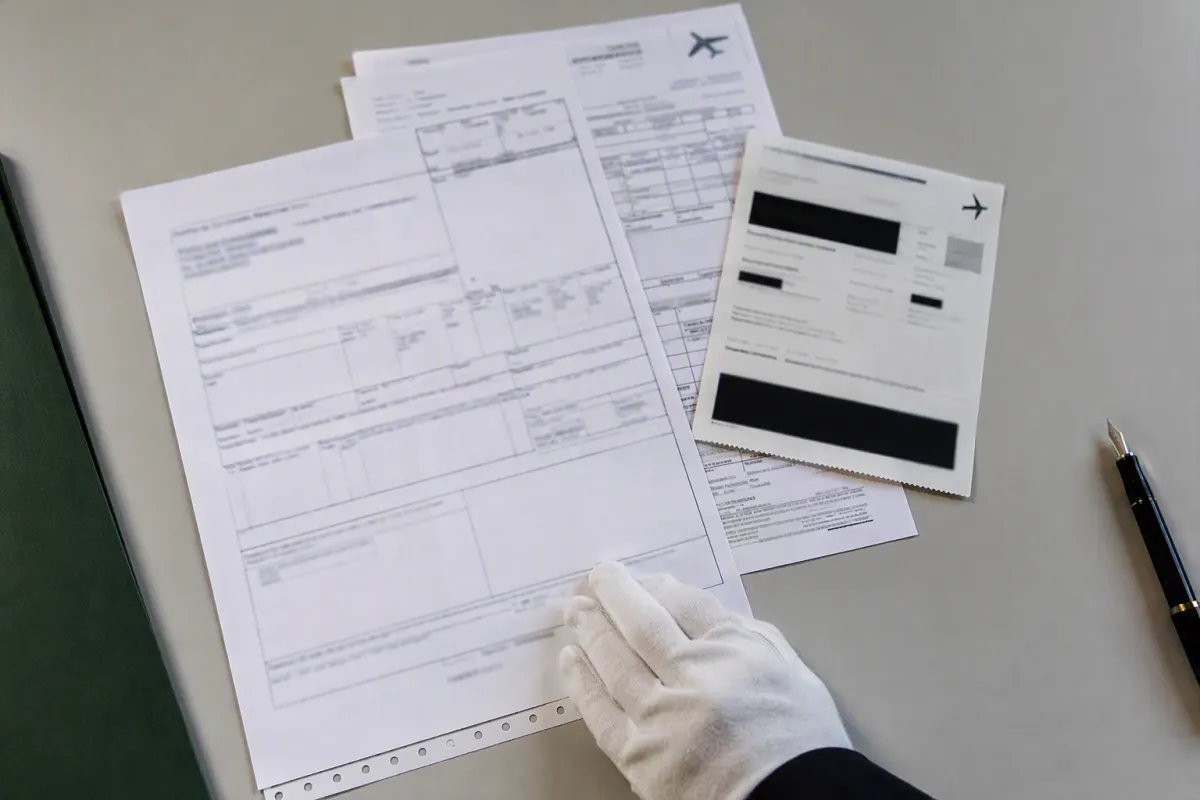
Cemeteries and funeral directors in Germany will only accept an urn with papers showing who died and that the urn contains only that person’s ashes. The urn’s arrival must also be announced in advance to the cemetery or funeral director in Germany.
| Document | Issued by | What to watch for |
|---|---|---|
| Death certificate | Civil registry in the country of death | From EU countries: accepted without an apostille; on request with a multilingual standard form instead of a translation. From non-EU countries: usually with an apostille or legalisation and a certified German translation |
| Cremation certificate (Einäscherungsbescheinigung) | Crematorium in the country of death | Confirms the cremation and that the urn contains only the deceased’s ashes |
| Urn certificate (Urnenbescheinigung, often called “Urnenpass”) | German embassy or consulate general in the country of death | Mainly for transfers from non-EU countries. Usually requires the death certificate, cremation confirmation, passport or passport copy and details of the transport route. A fee is charged |
| Passport or ID copy of the deceased | – | For the urn certificate and identification |
| Confirmation of burial | Cemetery or funeral director in Germany | Confirms that the urn will be accepted and buried there |
German missions abroad issue the urn certificate but do not help with the transport itself. In some countries urns are not released to private individuals at all — the German Foreign Office points this out for Russia, for example. In that case a funeral director has to be involved anyway. Our glossary explains the German terms.
Customs: EU or non-EU
From an EU country there is no customs border. No customs declaration is needed; only the papers for the cemetery and the airline matter.
From a non-EU country — including the UK, Turkey or Ukraine — a specific relief applies: under Article 113 of the EU Duty Relief Regulation, coffins containing bodies and urns containing the ashes of deceased persons are exempt from import duties. German customs lists this case explicitly among its duty reliefs. An urn is not merchandise; neither customs duty nor import VAT is charged. Exempt does not mean unchecked, though: air freight is cleared through customs at the airport, and if you carry the urn yourself, keep the death certificate and cremation certificate to hand.
How the urn gets to Germany
- As air freight through a funeral director. The usual route over longer distances. The urn travels with its own cargo documents, is X-rayed and cleared through customs, and is collected at the destination airport by the funeral director, who takes it to the cemetery.
- By road. Within Europe often simpler, as there is no cargo terminal in between.
- In a relative’s hand luggage. Many airlines allow this, but the rules differ considerably. Transavia, for instance, accepts urns in cabin baggage only, not made of metal, and with the death certificate and crematorium certificate. Vueling allows cabin or checked baggage if the urn is hermetically sealed and packed so it is not recognisable as an urn. The urn must be X-rayable at security. Check the conditions with the airline before booking.
- No longer by post. Deutsche Post and DHL stopped shipping urns, both within Germany and internationally, on 1 October 2025.
Even if you carry the urn yourself, you need a cemetery or funeral director in Germany to accept it. We can handle that part even if you arrange the journey yourself.
The process in six steps
- Call and assessment. Where are the deceased or the urn, where will the burial take place, is there insurance? You then receive a written fixed price.
- Cremation in the country of death. If it has not yet taken place, our local partner arranges it under local rules.
- Documents. Death certificate, cremation certificate and, depending on the country, apostille and translation.
- Urn certificate. Where required, applied for at the German embassy or consulate general.
- Transport and import. By air freight or road, with customs clearance for imports from non-EU countries.
- Handover in Germany. To the cemetery or funeral director of your choice — or we accompany the burial as well.
How long it takes
The transport itself is usually the shortest stage. The overall time depends mainly on the authorities in the country of death: when the body is released, when the crematorium has a slot, and how quickly the certificate, apostille and urn certificate are ready. From elsewhere in Europe it often goes quickly; with complex legalisation or over public holidays it can take noticeably longer. We will give you a reliable time frame once we know the situation on the ground.
What it costs to bring an urn to Germany
| Item | Amount |
|---|---|
| Urn transfer from abroad to Germany | €1,500 – 3,500 guide price |
| Cremation in the country of death, if not yet done | Fixed price on request, depends on the country |
| Urn certificate, apostille, translations | Fees of the respective authorities |
| Grave, burial and cemetery fees in Germany | According to the cemetery’s fee schedule (Gebührensatzung) |
Each cemetery operator sets its own fees, and they vary widely between towns and municipalities. Ask the cemetery at the place of residence for its fee schedule early on. If your relative died while travelling, travel health insurance often covers the repatriation in full or in part — we check that with you first. More on the page urn repatriation.
Death on holiday: cremation abroad or repatriation in a coffin?
When a relative dies abroad, this decision often has to be made within hours. Cremation locally followed by an urn transfer is considerably cheaper and simpler in terms of paperwork, because the zinc-lined coffin and the corpse passport are not needed. On the other hand, there is no farewell at the coffin in Germany, and the decision cannot be reversed.
- Faith: Islam and Judaism do not permit cremation, and the Orthodox churches are reserved about it. If in doubt, speak to a member of the clergy first.
- The wishes of the deceased: is there a directive, or did they say how they wanted to be buried?
- Insurance: some insurers want to commission the repatriation themselves. Clarify this before signing anything locally.
How repatriation in a coffin works and what it costs is explained on the page repatriation to Germany. More about cremation itself under cremation.
Frequently asked questions
Call us — we will work out the urn’s route
Tell us which country the deceased or the urn is in and where in Germany the burial will take place. We will tell you which papers are missing, which transport route fits and what it costs — in writing, within a few hours. For over 20 years we have been repatriating the deceased in both directions, in English, German, Russian and Ukrainian.
Phone: +49 1511 7463888, around the clock · Request a call-back
Legal information as of September 2026. Burial law in Germany is set by the federal states; binding information is provided by the cemetery or the competent local authority.