Urn repatriation abroad
If the ashes are to be laid to rest in the home country, different rules apply than for a coffin repatriation — in some respects simpler, in others more complicated. Here you will find what is required, what it costs and how to follow the shipment on its way.
- No mortuary passport (Leichenpass) needed
- Shipment tracking by AWB
- Available around the clock
- German, Russian, Ukrainian and English
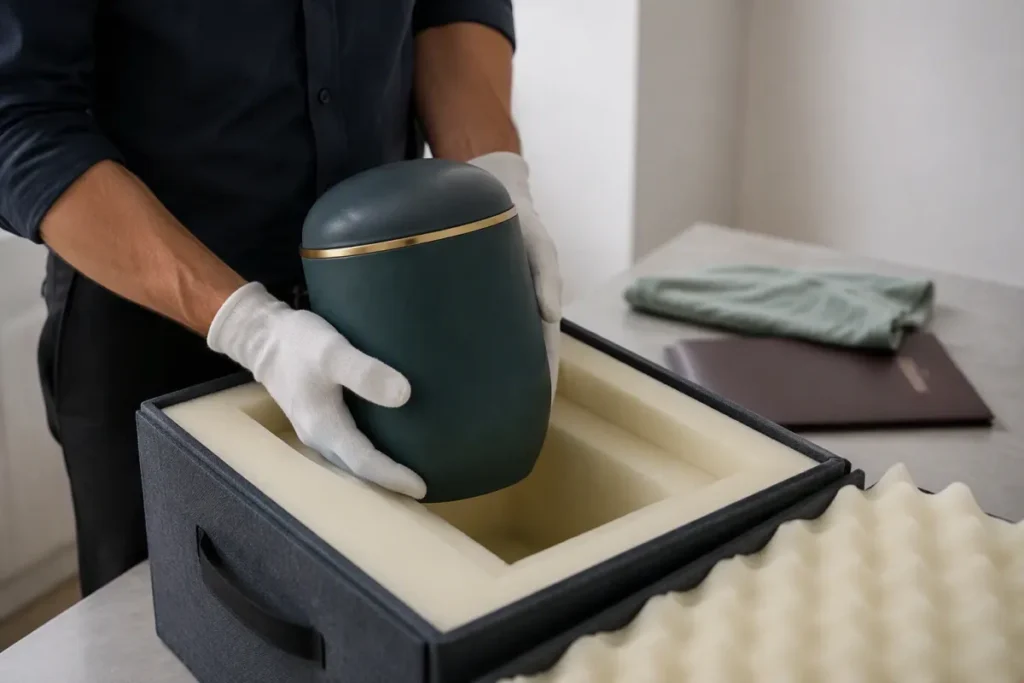
Urn repatriation at a glance
- from €990urn repatriation, depending on destination and scope; fixed price in advance
- approx. 1 weekwithin Europe from release of the urn, intercontinental 1–2 weeks
- no Leichenpassdeath certificate, cremation certificate, urn passport depending on the country
- AWB numbershipment trackable via air waybill, we confirm the handover
- fixed pricein writing within a few hours, available 24/7
How an urn repatriation works
Five steps from your first call to the handover in the destination country. You have one fixed contact person throughout.
Call
You tell us the destination and where the deceased currently is. You receive the fixed price in writing within a few hours.
Power of attorney
You sign a power of attorney. We handle the registry office, health authority, crematorium and consulate.
Cremation
If not yet done: after the second medical examination and the statutory waiting period of 24 to 48 hours.
Air freight
The urn is packed securely and booked. You receive the AWB number, flight and arrival time.
Handover
Our partner funeral director collects the urn at the destination airport. We let you know as soon as the handover is confirmed.
For an urn you do not need a mortuary passport (Leichenpass)
If a person has been cremated in Germany and the urn is to go abroad, the most important difference from a coffin repatriation is this one — and it is often presented incorrectly. The Berlin Agreement (Berliner Abkommen) of 1937, which governs the international transport of the deceased and prescribes the mortuary passport (Leichenpass), expressly does not apply to human ashes. The Federal Association of German Funeral Directors (Bundesverband Deutscher Bestatter) puts it unambiguously: the transfer of an urn to another country does not require a mortuary passport (Leichenpass).
Nevertheless, some German authorities issue a document called “urn pass (Urnenpass)” or “international mortuary passport / urn pass (Internationaler Leichenpass/Urnenpass)”. Depending on the federal state, the public health office (Gesundheitsamt) or the local regulatory authority is responsible; the fees are usually around 25 to 45 euros. Whether this document is needed in your case depends less on Germany than on the destination country and the airline. We clarify that before booking, so that the urn is not left standing at the cargo terminal.
Which documents are actually needed
The core is manageable. Everything else follows from the destination country.
- Death certificate (Sterbeurkunde), for use abroad in the international multilingual form issued by the registry office (Standesamt)
- Cremation certificate (Einäscherungsbescheinigung) from the crematorium
- Confirmation from the funeral home that the urn contains the ashes of the deceased person — airlines and German missions abroad regularly ask for this confirmation
- Urn pass (Urnenpass) or permit from the competent authority, if the destination country or the airline requires it
- Release by the public prosecutor’s office, if the manner of death was not classified as natural
- Apostille and certified translations — customary for many non-EU states, usually not needed within the EU
- Import permit from the destination country — expressly provided for by some states, such as the USA, Canada and Australia
In Germany, the second post-mortem examination (zweite Leichenschau) always precedes the cremation itself. Without this medical clearance no crematorium may act. We take care of the coordination with the registry office (Standesamt), the public health office (Gesundheitsamt), the crematorium and the consulate; you sign a power of attorney.
What an urn repatriation costs
An urn repatriation is considerably cheaper than a coffin repatriation to the same country. The reason is simple: there is no zinc coffin, no encoffining, no soldering and a large part of the freight weight is saved. How big the gap turns out to be depends on the destination country. Simple urn repatriations start at €990.
| Destination region | Urn, guide price | For comparison: coffin |
|---|---|---|
| Ukraine | €3,500 – 4,500 | €3,500 – 8,500 |
| Russia | €4,500 – 7,500 | €6,500 – 9,500 |
| Kazakhstan, Uzbekistan, Central Asia | €3,500 – 4,500 | €6,500 – 9,500 |
| Georgia, Armenia, Azerbaijan | €2,500 – 3,500 | €4,500 – 7,500 |
| To Germany — after cremation in the country of death | €1,500 – 3,500 | individual |
Non-binding guide prices, as at August 2026. Cremation in Germany is not included and is charged separately. For Poland, the Balkans, Turkey, North Africa and other destinations we calculate individually — the enquiry costs nothing and commits you to nothing.
Why there are cheaper offers — and when they are the right fit
Online you will find urn shipping from around 80 to 110 euros. These offers are reputable, but they provide something different. The difference lies not in the transport, but in everything that happens before it.
When a pure shipping service is enough
The cremation has already taken place, all the papers are complete, and in the destination country someone takes receipt of the urn at its destination. In that case a shipping service is the cheaper and entirely right choice. We tell you that openly — on the telephone as well.
What our fixed price covers
Collection of the deceased in Germany, hygienic care through our partners, urn container and transport-safe packaging, all documents, coordination with the registry office (Standesamt), the public health office (Gesundheitsamt), the crematorium and the consulate, customs clearance, the transport itself and the handover to the partner funeral director in the destination country.
Not included are certified translations and legalisations, should the destination country require them, and the burial on site — the partner funeral director invoices the family for that directly. You will find a detailed breakdown on our page Costs of a repatriation abroad.
Urn repatriation by country: documents, duration, guide price
These are among the countries we arrange urn repatriations to. Search for your destination or filter by region. The duration applies from the release of the urn; we check exactly which certifications are required for your case before booking.
| Destination | Certification of documents | Duration | Urn, guide price |
|---|---|---|---|
| Ukraine CIS & Eastern Europe | Apostille or legalisation possible | approx. 1 week | €3,500 – 4,500 |
| Russia CIS & Eastern Europe | Apostille or legalisation possible | 1–2 weeks | €4,500 – 7,500 |
| Belarus CIS & Eastern Europe | Apostille or legalisation possible | 1–2 weeks | on request |
| Moldova CIS & Eastern Europe | Apostille or legalisation possible | approx. 1 week | on request |
| Kazakhstan Central Asia | Apostille or legalisation possible | 1–2 weeks | €3,500 – 4,500 |
| Uzbekistan Central Asia | Apostille or legalisation possible | 1–2 weeks | €3,500 – 4,500 |
| Kyrgyzstan Central Asia | Apostille or legalisation possible | 1–2 weeks | €3,500 – 4,500 |
| Tajikistan Central Asia | Apostille or legalisation possible | 1–2 weeks | €3,500 – 4,500 |
| Turkmenistan Central Asia | Apostille or legalisation possible | 1–2 weeks | €3,500 – 4,500 |
| Georgia Caucasus | Apostille or legalisation possible | 1–2 weeks | €2,500 – 3,500 |
| Armenia Caucasus | Apostille or legalisation possible | 1–2 weeks | €2,500 – 3,500 |
| Azerbaijan Caucasus | Apostille or legalisation possible | 1–2 weeks | €2,500 – 3,500 |
| Poland EU | EU: usually no apostille | approx. 1 week | on request |
| Czech Republic EU | EU: usually no apostille | approx. 1 week | on request |
| Slovakia EU | EU: usually no apostille | approx. 1 week | on request |
| Hungary EU | EU: usually no apostille | approx. 1 week | on request |
| Romania EU | EU: usually no apostille | approx. 1 week | on request |
| Bulgaria EU | EU: usually no apostille | approx. 1 week | on request |
| Croatia EU | EU: usually no apostille | approx. 1 week | on request |
| Slovenia EU | EU: usually no apostille | approx. 1 week | on request |
| Greece EU | EU: usually no apostille | approx. 1 week | on request |
| Cyprus EU | EU: usually no apostille | approx. 1 week | on request |
| Estonia EU | EU: usually no apostille | approx. 1 week | on request |
| Latvia EU | EU: usually no apostille | approx. 1 week | on request |
| Lithuania EU | EU: usually no apostille | approx. 1 week | on request |
| Sweden EU | EU: usually no apostille | approx. 1 week | on request |
| Finland EU | EU: usually no apostille | approx. 1 week | on request |
| Denmark EU | EU: usually no apostille | approx. 1 week | on request |
| Belgium EU | EU: usually no apostille | approx. 1 week | on request |
| Netherlands EU | EU: usually no apostille | approx. 1 week | on request |
| Luxembourg EU | EU: usually no apostille | approx. 1 week | on request |
| France EU | EU: usually no apostille | approx. 1 week | on request |
| Austria EU | EU: usually no apostille | approx. 1 week | on request |
| Italy EU | EU: usually no apostille | approx. 1 week | on request |
| Spain EU | EU: usually no apostille | approx. 1 week | on request |
| Portugal EU | EU: usually no apostille | approx. 1 week | on request |
| Ireland EU | EU: usually no apostille | approx. 1 week | on request |
| Serbia Europe outside the EU | Apostille or legalisation possible | approx. 1 week | on request |
| North Macedonia Europe outside the EU | Apostille or legalisation possible | approx. 1 week | on request |
| Montenegro Europe outside the EU | Apostille or legalisation possible | approx. 1 week | on request |
| Bosnia and Herzegovina Europe outside the EU | Apostille or legalisation possible | approx. 1 week | on request |
| Albania Europe outside the EU | Apostille or legalisation possible | approx. 1 week | on request |
| Kosovo Europe outside the EU | Apostille or legalisation possible | approx. 1 week | on request |
| Turkey Europe outside the EU | Apostille or legalisation possible | approx. 1 week | on request |
| Switzerland Europe outside the EU | Apostille or legalisation possible | approx. 1 week | on request |
| Norway Europe outside the EU | Apostille or legalisation possible | approx. 1 week | on request |
| Iceland Europe outside the EU | Apostille or legalisation possible | approx. 1 week | on request |
| United Kingdom Europe outside the EU | Apostille or legalisation possible | approx. 1 week | on request |
| Andorra Europe outside the EU | Apostille or legalisation possible | approx. 1 week | on request |
| Monaco Europe outside the EU | Apostille or legalisation possible | approx. 1 week | on request |
| Gibraltar Europe outside the EU | Apostille or legalisation possible | approx. 1 week | on request |
| USA Overseas | Apostille + import permit | 1–2 weeks | on request |
| Canada Overseas | Apostille + import permit | 1–2 weeks | on request |
| Australia Overseas | Apostille + import permit | 1–2 weeks | on request |
| New Zealand Overseas | Apostille or legalisation possible | 1–2 weeks | on request |
| Argentina Overseas | Apostille or legalisation possible | 1–2 weeks | on request |
| Brazil Overseas | Apostille or legalisation possible | 1–2 weeks | on request |
| South Africa Overseas | Apostille or legalisation possible | 1–2 weeks | on request |
| Morocco Overseas | Apostille or legalisation possible | 1–2 weeks | on request |
| Egypt Overseas | Apostille or legalisation possible | 1–2 weeks | on request |
| China Overseas | Apostille or legalisation possible | 1–2 weeks | on request |
| Japan Overseas | Apostille or legalisation possible | 1–2 weeks | on request |
Guide prices excluding cremation in Germany, as at September 2026. Simple urn repatriations are possible from €990. “On request” means: we give you a written fixed price within a few hours, and the enquiry is free. Import permits are required by the USA, Canada and Australia, among others. Our main focus is described on Repatriation to the CIS countries.
How the urn travels
There are two routes, and they differ considerably.
As air freight
The usual route. The urn is sealed dust-tight, padded and packed into a sturdy outer box, dispatched with the documents as freight papers and taken over in the destination country by the partner funeral director at the cargo terminal. Private individuals cannot as a rule book air freight of this kind themselves — here the airlines work exclusively with funeral companies and freight forwarders.
A practical note that many families are not yet aware of: Deutsche Post, that is DHL, discontinued urn shipping entirely, both nationally and internationally, on 1 October 2025. Anyone who still comes across older instructions for postal dispatch online should ignore them.
In hand luggage
Some airlines allow you to take the urn with you yourself — with most of them then only in hand luggage, while individual airlines also permit checked baggage. Three conditions are customary: the urn should not be made of metal, so that it can pass through the security check; it must be packed in such a way that fellow travellers do not recognise what it is; and the death certificate (Sterbeurkunde) and the crematorium’s certificate must be carried.
The rules do, however, differ from airline to airline, and individual carriers exclude the carriage of urns altogether in their conditions of carriage. So do not rely on general information; instead, have the carriage confirmed to you in writing beforehand by the specific airline. We do that for you on request, even if you then fly yourself.
Tracking an urn repatriation: where the shipment is right now
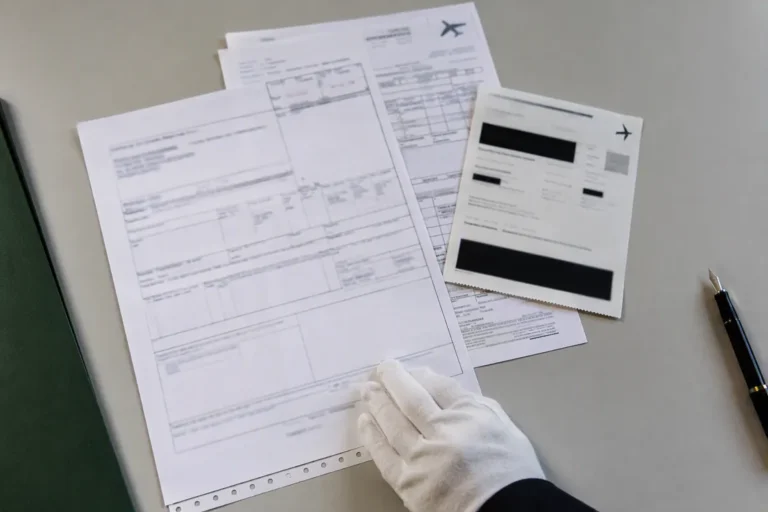
As soon as the urn is on its way, that is the question we are asked most often. So here is how shipment tracking actually works with an urn repatriation.
An air waybill (AWB) is issued for every air freight shipment — the freight document that accompanies the shipment along its entire route. The AWB number consists of eleven digits; the first three identify the airline. This number allows the status of the shipment to be followed.
As soon as the booking is confirmed, you receive from us:
- the AWB number of the shipment
- flight number, departure time and scheduled arrival time
- name and contact details of the partner funeral director who takes charge of the urn in the destination country
- a message from us as soon as the handover at the destination airport is confirmed
How much detail an airline shows for the shipment status online differs from carrier to carrier — some show every transfer point, others only departure and arrival. If the display remains unclear, we ask the freight department directly on your behalf.
And if something is delayed?
Rebookings do happen, usually because of freight capacity or the weather. In that case we contact you on our own initiative, with the new flight and the new arrival time — and we inform the partner funeral director in the destination country, so that nobody waits at the terminal in vain.
How long it takes
Between the death and the cremation, a statutory waiting period of 48 hours applies in most federal states; North Rhine-Westphalia (Nordrhein-Westfalen) and Mecklenburg-Western Pomerania (Mecklenburg-Vorpommern) already permit cremation after 24 hours. Decisive is the funeral law of the respective state. After that come the second post-mortem examination (zweite Leichenschau), the issuing of the death certificate (Sterbeurkunde) and, depending on the destination country, the consular steps.
In practice, for an urn repatriation within Europe you should reckon with about a week from the release of the urn, and with one to two weeks for intercontinental destinations. What delays the process is almost never the flights, but missing or incorrect papers. That is why we check the documents before we book.
Urns within Germany and to Germany
Not every urn repatriation goes abroad. These two cases occur more often than many people think.
Transferring an urn within Germany
If the urn is to be taken to another federal state or another city, the consulate, customs and import permit do not apply. What remains are the death certificate (Sterbeurkunde), the cremation certificate (Einäscherungsbescheinigung) and the registration with the cemetery at the place of burial. We handle the transport throughout Germany; how this works in detail is set out on our page Transport within Germany.
Transferring an urn from abroad to Germany
Someone dies on holiday or abroad, is cremated there, and the family would like the burial to take place in Germany. Here the German obligation to bury (Bestattungspflicht) applies — the urn must be interred on a dedicated site, and the cemetery needs the cremation certificate (Einäscherungsbescheinigung) as well as the translated death certificate (Sterbeurkunde). We take care of the coordination with the funeral director in the country of origin, the transport and the handover. More on this at Repatriation to Germany.
The cemetery requirement (Friedhofszwang) applies to the ashes as well
A point that should be spoken about openly, because it can get families into difficulties. In Germany the obligation to bury (Bestattungspflicht) applies not only to the body but also to the ashes: they must be interred on a site dedicated for that purpose. Individual federal states have meanwhile relaxed their laws — Bremen has allowed scattering under certain conditions since 2015, and Rhineland-Palatinate (Rheinland-Pfalz) fundamentally opened up its funeral law in autumn 2025 — yet nationwide the rule continues to be interment.
Exporting the urn for an actual burial abroad is permitted and an everyday matter. What is not permitted is to take the urn abroad in order to bring it back to Germany privately afterwards. That is a regulatory offence and can result in a substitute performance at the family’s cost (Ersatzvornahme). We therefore only organise a repatriation to a place where a burial actually takes place, and we have the place of burial in the destination country confirmed to us. That is not a formality, it is your protection.
Frequently asked questions
What does an urn repatriation abroad cost?+
Simple urn repatriations are possible from 990 euros. Considerably less than a coffin repatriation to the same country. As guide prices: Georgia, Armenia and Azerbaijan 2,500 to 3,500 euros, Ukraine as well as Kazakhstan and Central Asia 3,500 to 4,500 euros, Russia 4,500 to 7,500 euros. We will give you the binding fixed price after a short conversation in which the destination country, the place of collection and the desired date have been established.
Why is urn shipping available from around 100 euros?+
Because that is a different service. Pure shipping services transport an urn that has already been handed over ready for dispatch from A to B; the sender has to obtain all the documents themselves. Our fixed price covers the entire journey — collection of the deceased, dealings with the authorities, papers, customs and handover to the partner funeral director in the destination country.
Do I need a mortuary passport (Leichenpass) for an urn?+
No. The Berlin Agreement (Berliner Abkommen), which requires the mortuary passport (Leichenpass), expressly does not apply to human ashes. Some destination countries and some airlines do, however, require a so-called urn pass (Urnenpass), which in Germany is issued by the public health office (Gesundheitsamt) or the regulatory authority, depending on the federal state.
How can I track the urn repatriation?+
Via the AWB number of the air freight shipment. You will receive from us the AWB number, the flight number and the departure and scheduled arrival times, together with the contact details of the partner funeral director in the destination country. How much detail an airline shows for the status online varies; if the display is unclear, we ask the freight department on your behalf.
May I take the urn with me on the plane myself?+
With many airlines, yes. Most allow the urn only in hand luggage, some also in checked baggage — and some exclude carriage altogether. What is customary is an urn without any metal content, opaque packaging and the original death certificate (Sterbeurkunde) and crematorium certificate. The conditions of carriage of your airline are always decisive.
Can I send the urn by post?+
No longer via DHL. Urn shipping was discontinued there, nationally and internationally, on 1 October 2025. The regular route today is air freight via a funeral company.
How long does it take altogether?+
Within Europe about a week from the release of the urn, intercontinentally one to two weeks. Before that come the statutory waiting period prior to cremation — 48 hours in most federal states, 24 in North Rhine-Westphalia (Nordrhein-Westfalen) and Mecklenburg-Western Pomerania (Mecklenburg-Vorpommern) — and the second post-mortem examination (zweite Leichenschau).
Can an urn be repatriated from abroad to Germany?+
Yes, that is a frequent case. The German obligation to bury (Bestattungspflicht) then applies: the urn must be interred on a dedicated site. The cemetery requires the cremation certificate (Einäscherungsbescheinigung) and the translated death certificate (Sterbeurkunde). We take care of the coordination with the funeral director in the country of origin, the transport and the handover.
What does it cost to bring an urn to Germany?+
If the deceased was cremated abroad, the guide price for bringing the urn to Germany is 1,500 to 3,500 euros, depending on the country of origin. This covers coordination with the local funeral director, transport and handover to the cemetery or funeral home in Germany.
Are there countries to which an urn cannot be repatriated?+
We are not aware of a general import ban on urns in any country. Something else is relevant in practice: in countries shaped by Islam and Judaism, cremation is not provided for religiously, so an urn burial there is usually not possible. In addition there are political situations that make individual routes temporarily impossible.

Rudolf Nordheimer
Tell us where the urn is to go and where the deceased is currently located — we take care of everything else. Available around the clock, at night and at weekends too, in German, Russian, Ukrainian and English.
A first conversation costs nothing and commits you to nothing. Call-back service · For coffin repatriations see International repatriations.
This text reflects the status of the published regulations and does not replace legal advice. Binding are the requirements of the competent authority and of the destination country.